
Best Telescope Eyepieces for Planetary Viewing: Enhancing Your Star Gazing Experience
Have you ever marveled at the twinkle of Venus or the rings of Saturn through a telescope? The magic of these moments is not just in seeing, but in the clarity and detail that the right equipment can provide. A telescope is only as good as its eyepiece, and for those passionate about planetary viewing, choosing the right eyepiece is paramount. This guide dives deep into the world of telescope eyepieces designed with planetary viewing in mind, ensuring that each gaze you take into the cosmos is as breathtaking as it is detailed.
Choosing an eyepiece for planetary observation is quite different from selecting one for other types of stargazing. Planets demand high magnification and excellent contrast to view details like cloud bands and moon transits. This article focuses on eyepieces that enhance these features, so you, too, can experience the awe-inspiring sights our solar system has to offer.
But why is the eyepiece so crucial, and what makes one better suited for viewing planets? An eyepiece that excels in planetary viewing typically offers high magnification capabilities, superior lens quality, and special coatings to maximize light transmission and contrast. Such features transform your stargazing from a simple hobby into a journey across the planetary surfaces of our solar system.
This curated list details some of the best eyepieces available for planetary viewing, selected based on their optical quality, field of view, comfort in use, and user feedback. Whether you are a novice beginning your astronomic adventures or a seasoned stargazer looking for an upgrade, this guide will help you choose the right eyepiece to enhance your planet-watching experience.
1. Celestron X-Cel LX Series Eyepiece
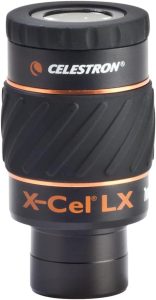
The Celestron X-Cel LX series eyepieces are a stellar choice for those seeking to delve deeper into planetary observation. Boasting a comfortable 60-degree field of view and enhanced optics coated for better contrast and brightness, these eyepieces bring your planetary viewing experience to life.
Especially designed for stargazers who enjoy detailed, up-close views of planetary bodies, the X-Cel LX series stands out with its 7-element optical design. This design ensures sharp focus and minimizes spherical aberration, which is a common challenge when observing planets.
One of the practical features of this eyepiece series is its 16mm eye relief, which provides comfortable viewing for observers, even those who wear glasses.
Key Benefits
- 7-element optical design for sharp clarity
- Wide 60-degree field of view
- 16mm eye relief, suitable for eyeglass wearers
- Durable coating for enhanced contrast and brightness
Expert Tips
Choosing the perfect eyepiece for planetary viewing is not just about budget and specs — it’s also about matching your eyepiece to your specific telescope and viewing conditions. Here are expert tips to enhance your stargazing:
- Consider Your Telescope’s Focal Length: Pairing your telescope with the right eyepiece focal length is critical for achieving the desired magnification.
- Experiment With Different Magnifications: Higher isn’t always better. Sometimes, moderate magnification can provide clearer images, especially under less-than-ideal atmospheric conditions.
- Maintain Your Eyepieces: Regular cleaning and careful handling can significantly extend the life and performance of your eyepieces.
Common Mistakes to Avoid
Even seasoned stargazers can fall prey to common pitfalls when choosing or using telescope eyepieces for planetary observation:
- Ignoring Eye Relief: If you wear glasses, insufficient eye relief can hinder your ability to see the full field of view.
- Overlooking Atmospheric Conditions: High magnification can backfire if atmospheric conditions aren’t stable. Always adapt your eyepiece choice to the current viewing conditions.
- Choosing Based Only on Price: While it’s important to adhere to a budget, remember that the cheapest options might not provide the clarity and detail needed for satisfying planetary viewing.
Frequently Asked Questions
What is eye relief, and why is it important?
Eye relief is the distance from the surface of an eyepiece lens to the observer’s eye that allows the full field of view to be seen comfortably. This is especially crucial for those who wear eyeglasses.
Can higher magnification provide better views of the planets?
Not necessarily. Higher magnification can increase the image size, but it can also make the image fainter and more affected by atmospheric turbulence. Finding a balance based on your telescope’s capabilities and the prevailing atmospheric conditions is key.
How do I know if an eyepiece is compatible with my telescope?
Check the barrel size of the eyepiece — commonly 1.25 inches or 2 inches — which must match your telescope’s focuser or adapter. Also, consider the recommended focal lengths based on your telescope’s specifications.
Is it worth investing in multiple eyepieces?
Yes, having a range of eyepiece focal lengths can greatly enhance your viewing flexibility, allowing you to switch between different magnifications to best suit what you are observing and current atmospheric conditions.
How can I improve contrast when viewing planets?
Look for eyepieces with high-quality lens coatings and consider using a color filter which can enhance certain planetary features.
Can eyepieces be used with any type of telescope?
Most eyepieces are versatile but check for compatibility with your telescope type, such as refractor, reflector, or compound telescopes, to ensure optimal performance.
Final Thoughts
Upgrading your telescope with high-quality eyepieces can transform your planetary viewing experience from ordinary to extraordinary. By understanding the features that matter most — such as field of view, lens quality, and eye relief — and avoiding common mistakes, you can choose eyepieces that enhance your ability to explore the depths of our solar system. Remember that each night sky observation is unique, so continuously experiment with different eyepieces and settings to discover what works best for you under various conditions. May your planetary observations be as limitless as the universe itself.
As the stars above beckon, equip yourself with the best tools for the journey. The universe awaits, and every clear night is an invitation to walk among the cosmos. “